Wednesday, July 9, 2008

Nyonya Paste

Nyonya chicken
I love nyonya food but when it comes to cooking it, that is a different tale. I find that is one of the most tedious and with the most preparation. So when Betty cooked this delicious meehoon (vermicilli) kerabu and gave me the recipe for the rempah (spice paste), I had it sitting in the drawer for months before I finally gave it a try. Now, my preconception about Nyonya cooking has change but not that much...not as tedious (that's with a lot of help from the food processor) but still so much sobbing involved (the shallots, obviously). 
The result, I must say, was worth all the tears though. It was this heaven of aromatic fragrances that intoxicate all of the senses. 
It goes well with steam fish, fried fish, chicken and even pork, not just vermicelli.
I started off wanting to double the recipe as I figured I might as well get more for the the same amount of work and according to Betty this paste keeps well in the fridge for a month or so. Alas, it turned out I didn't have enough dried chillies, so I had to stick with one recipe and that turned out plenty, enough for at least 6 dishes! 


Blitz all the ingredients until fine in a food processor (and if you like the exercise or torture, use the mortar and pestle which some purists would swear make better paste).
With 2-3 tablespoon of oil, fry the paste over medium heat until fragrant and dry. Season with salt.
The paste keeps well in the fridge for a month or so.
The picture of nyonya chicken at the top most of this post was readied in just the time it took to cook through the chicken pieces, about 20 minutes. 

Nyonya Chicken
~~~~~~~~~~~~
1 chicken, chopped into small pieces
3 T nyonya paste
3-4 kaffir leaves*, washed and shredded coarsely
1 T sugar
2-3 T lime juice (can be substituted with yogurt or tamarind juice)
salt to taste

Marinate chicken pieces with the paste for 30 minutes or overnight in fridge. 
Heat up 1 T oil in wok and add chicken pieces to brown.
Add 1/4 cup of water and bring to boil, lower heat to simmer.
When chicken is soft, add kaffir leaves* (will give the dish a bitter taste if added too early), sugar, lime juice and salt to taste.
Cook until gravy thickens a bit and dish out. 

Nyonya Fish
It is just as easy with fish, just fry the fish as usual. Then add 1 or 2 tablespoon of the paste in. Add a little water, lime juice (or tamarind), sugar and salt to taste.
Voila...yum yum.

Friday, July 4, 2008

Biscotti From The U.S Of A

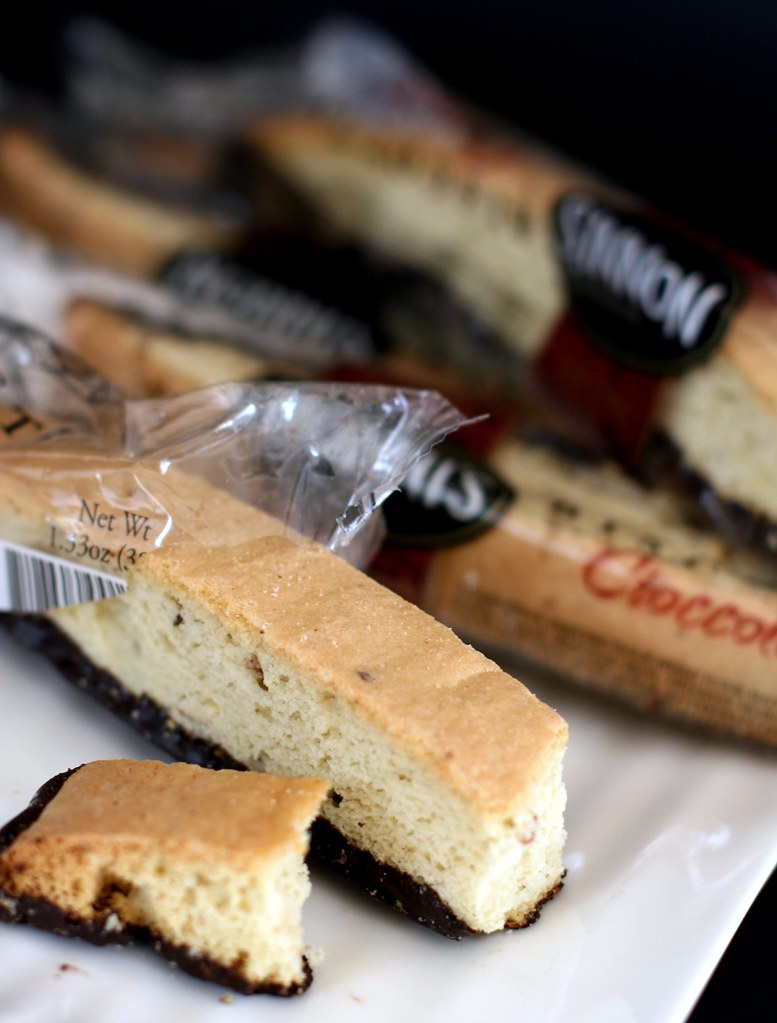
Got these from Mee Fung when K came back from the States. I turned pink when I remembered the first time I had biscotti in Rome and how, I wondered aloud to K, a nation that has such fine food came up with a biscuit that is so hard and dry, the almonds although tasty compounded to the rocky texture.
I had bleeding gums and painful jaws after having just one piece. 
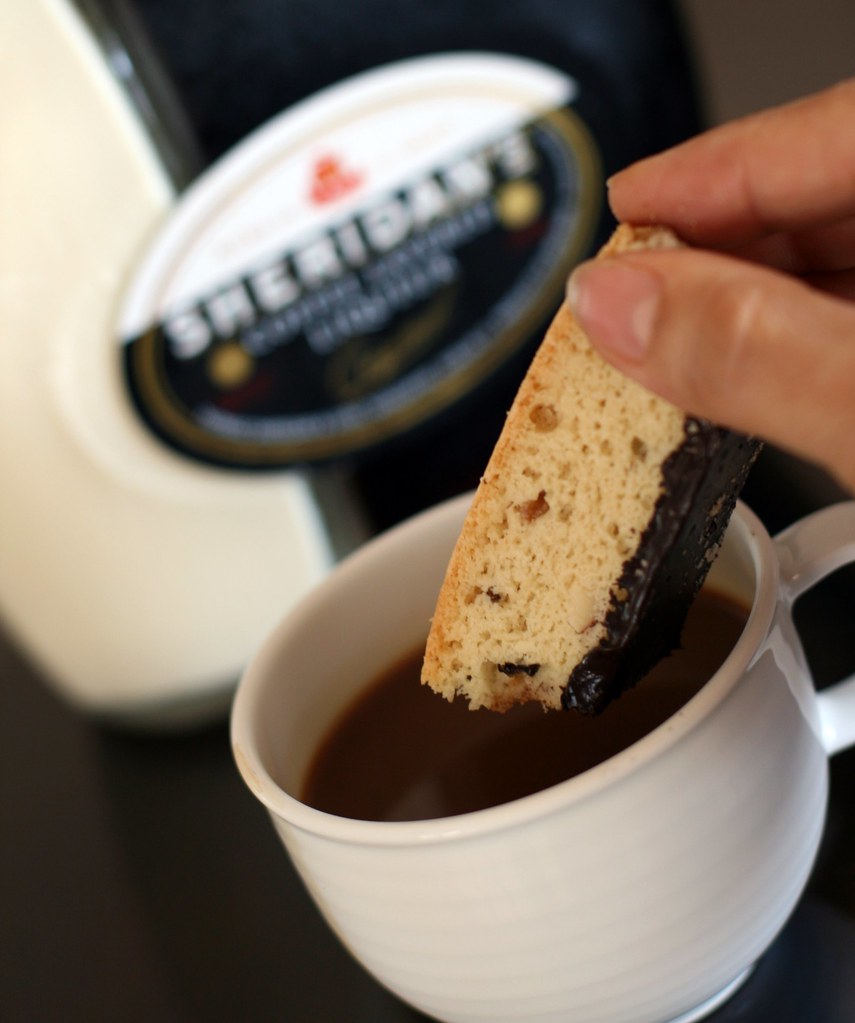
If only I knew then these were dunking biscuits, usually in liqueur (Vin Santo) with coffee... so sam pa lou! 
I was told  these biscotti are baked twice to make sure they are super hard! 

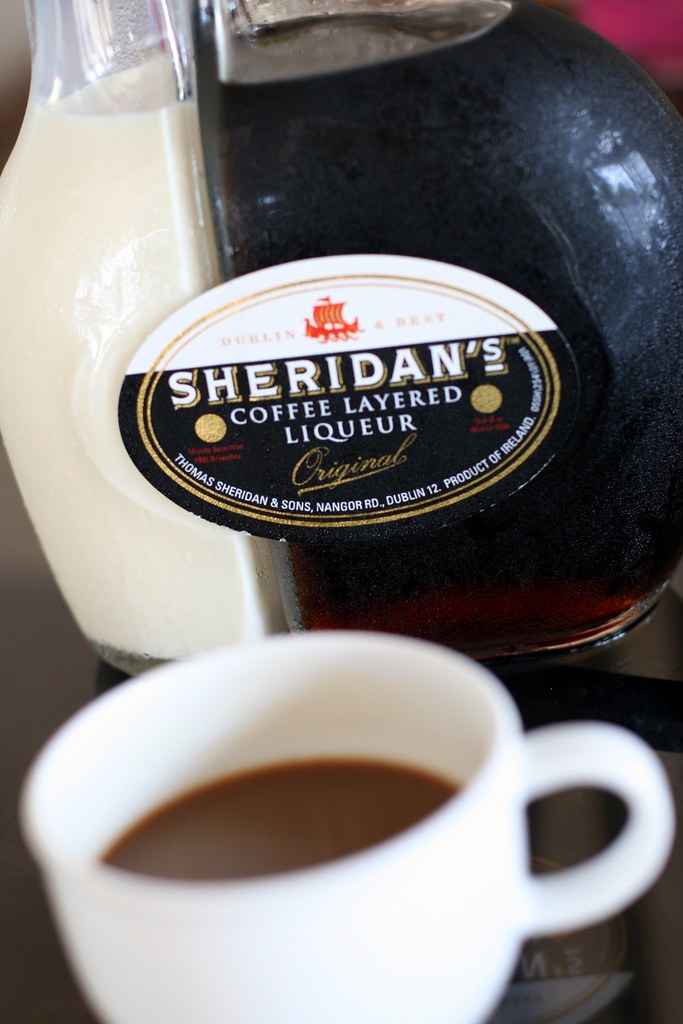
So here I made myself a black coffee as thick as can be (gau gau) with a dollop of this...
 
...coffee layered liqueur. Perfect day. 

I have since ran out of biscotti but with still half a bottle of this sweetness left. 
Maybe I'll do some home-baked biscotti. Anyone with a no-fail recipe for this biscuit? Like to share?

Have a lovely weekend.

Jo

Wednesday, June 25, 2008

Wild Yam with Pork


Another not so attractive dish to blog but tasty nonetheless.
Wild yam, I learned, is supposed to be very beneficial to women's health but I am not quite sure how, in what way and whether this is the same species. The site I researched on show a creeping vine with leaves that are very similar to the plant I grew. 
Anyway, let's not consider it medicinal because when I do that the food tend to loose their appeal and start to taste likewise. So, as long as it is edible and taste good ...
I cooked it with pork and dried shrimps. I am thinking this yam could also work in bubur cha cha...as taste and texture wise, very similar to the taro.

300 g wild yam, peeled and cubed
100 g pork, sliced thin
1 T dried shrimps, washed and drained
2 garlic cloves, chopped
1/4 t 5-spice powder (optional)
1 T soy sauce
salt and pepper

Marinade pork with salt, pepper and 5-spice powder, if use.
Heat 1 T oil in wok, add garlic and dried shrimps. Fry until fragrant, add pork and cook until color change. Add in yam, soy sauce, water to cover and mix well. Bring to boil and lower heat to simmer until yam is soft. Season with salt and pepper to taste.
 
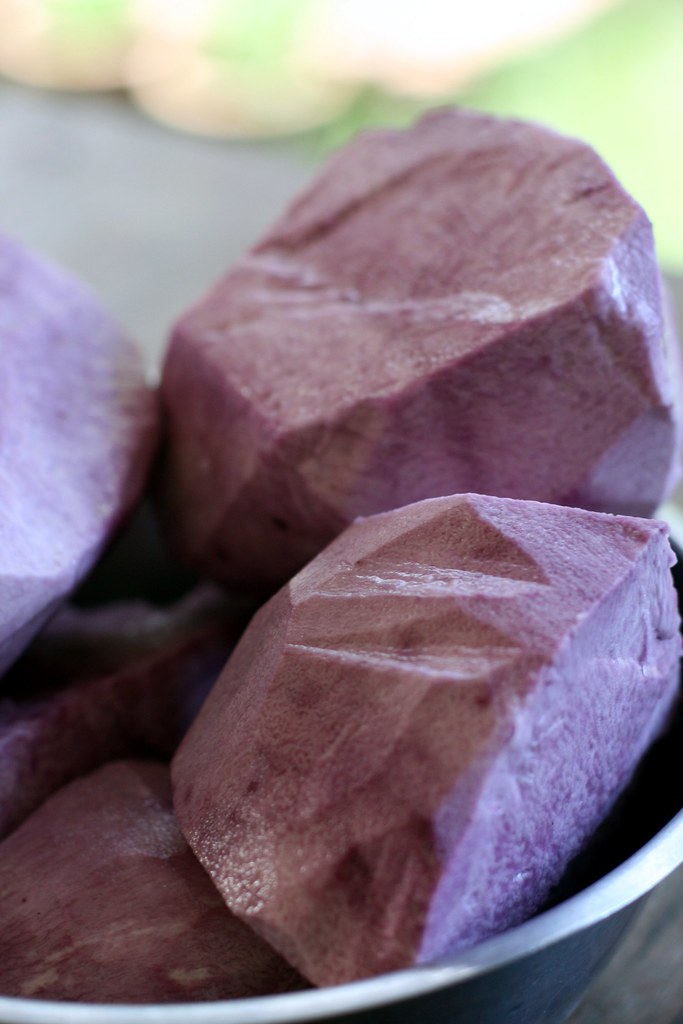
Dug out this wild yam from our back yard and it left behind a 2-feet crater. I think it must have weighed about 5 kg! I placed the garlic bulb next to it to give a perspective of the yam's size. 
Think I'll plant some more as they grow so easily, so much easier than the taro which I planted last year intending to make khew yuk for the lunar new year but harvest was so poor (miserly fist-size) I had to buy the yam from the market.

This is how it look like after peeling off the skin. Very purplish, crunchy and slimy.  

Jo 

Saturday, June 21, 2008

Braised Fish With Tomatoes


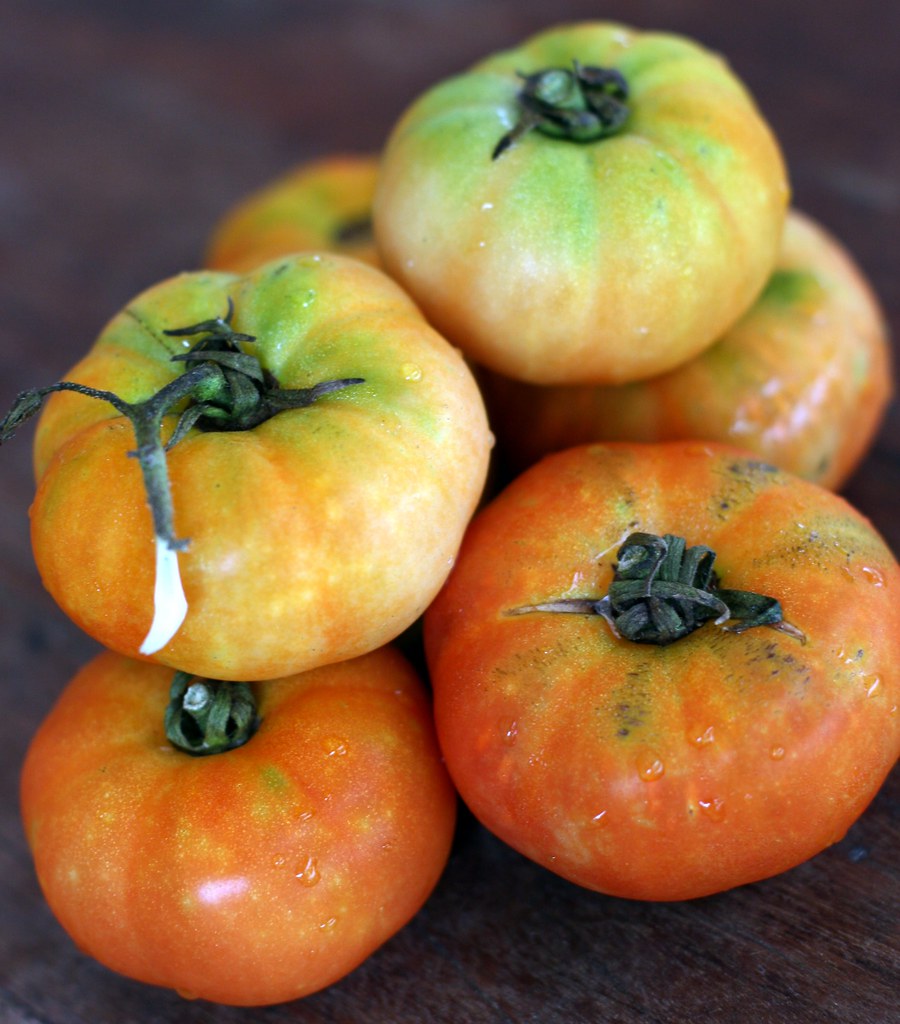
Grew up with these gorgeous heirloom tomatoes before the introduction of those genetically engineered strains. I just love the distinctly sweet yet acidic tangy flavor they impart.

They are usually smaller, flattened, have more pronounced ribbing (these ones shown above are so much rounder than usual, I hope they are not hybrid) and thinner flesh with more seeds than the normal plum or beefsteak tomatoes. They are not suitable for salad but are delicious when cooked with meat or fish.

Here I cooked the tomatoes with fish slices and tau cheong (fermented soy beans). For this gravy-loving family  this dish always calls for second helping of rice. 

Braised Fish With Tomatoes
~~~~~~~~~~~~~~~~~~~~
2 slices of fish
4 small tomatoes, sliced
2 cloves garlic, chopped
small thumb-size ginger, julienned
1 T tau cheong (sweet fermented soy bean)
salt and pepper
light soy sauce
sugar
1 T corn flour
1 red chili, seeded and julienned

Wipe dry fish and season with salt, pepper and coat thinly with corn flour.
Heat enough oil in wok to pan fry fish (wok must be very hot when oil is added and when just about to smoke, add fish slices (this would ensure the fish not sticking to the wok). 
Brown both sides well, take out and set aside.
Leave 1 T oil in the wok and add ginger and garlic, fry till fragrant.
Add tau cheong and chili (leave some for garnishing), fry for a minute or so and add the tomatoes.
Spread out the tomatoes slices at the base of wok and place the fish slices on top.
Pour about 1/2 cup of water in and bring to boil.
Lower heat and simmer for 10 - 15 minutes.
Turn the fish once during the simmering.
When the gravy thickens, season with sugar and light soy sauce.
Dish out and indulge with white steaming rice. Yum!

Thursday, June 19, 2008

Loh Hon Goh

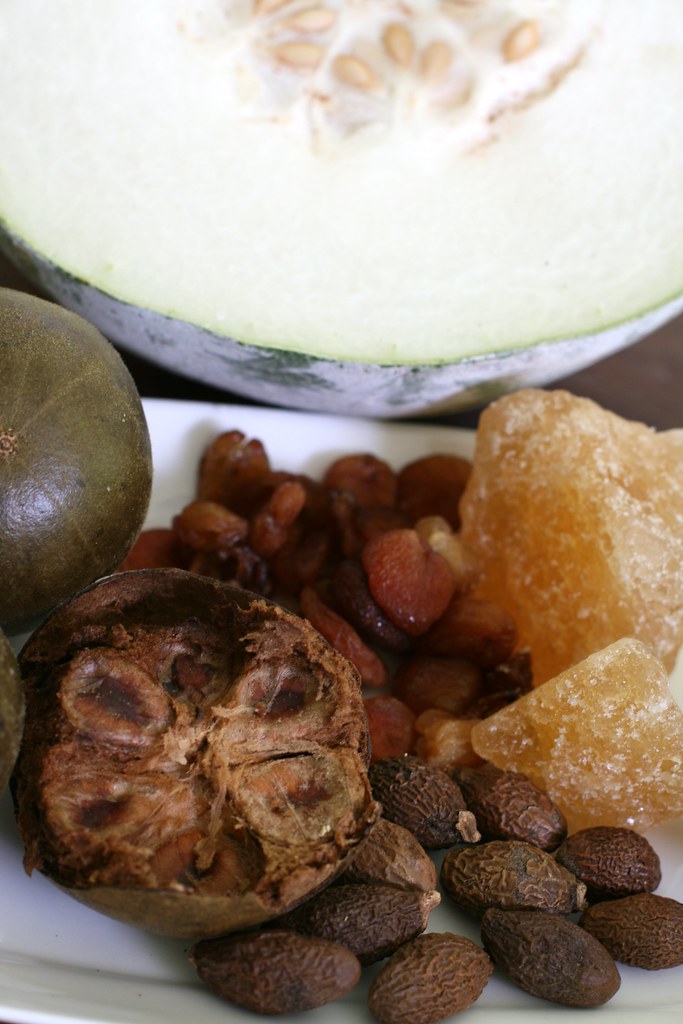
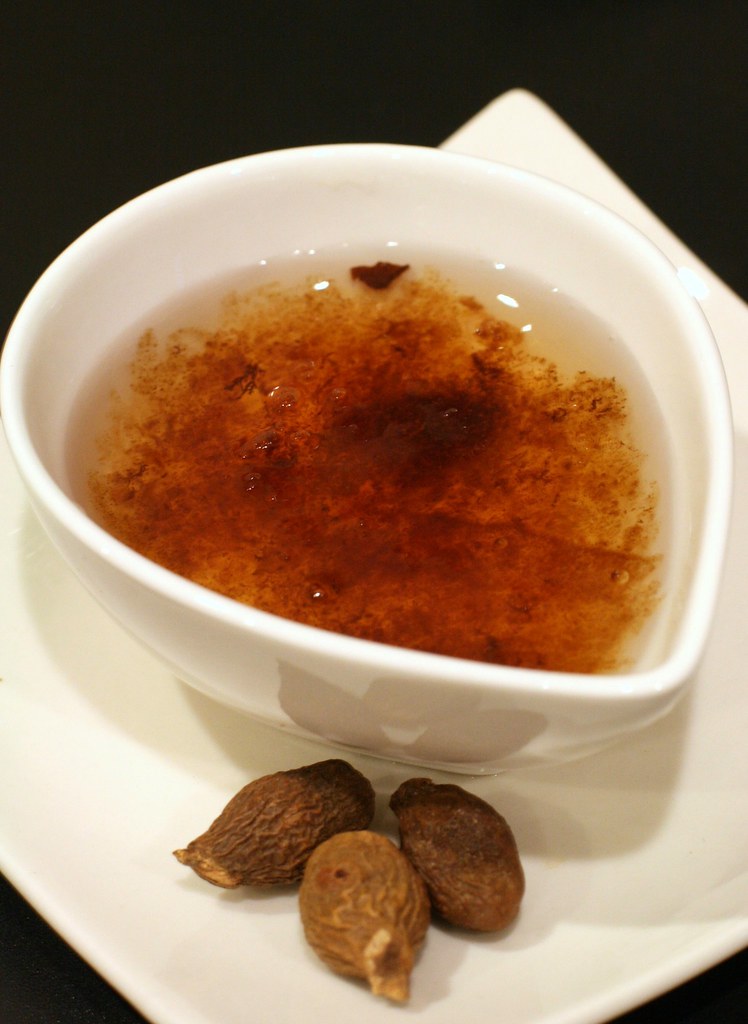
This best home-brewed tong sui recipe came from my sister, Pit, many years ago which has since become one of our favourites. We call it loh hon goh but I think in the kopitiam (coffee shop) it is referred to as tung kwa leong cha (winter melon cooling tea). I find most shops would use candied winter melon instead of fresh melon. It really taste so much more aromatic with fresh melon. Another trick to give this tong sui a rich caramel taste and aroma is to add a few pieces of gula melaka (palm sugar) when adjusting the taste. I also like to add more lieu (ingredient) like dried longan meat, thinly sliced dried persimmon or sea coconut, if available, to make this more a dessert than a drink.

Fresh winter-melon, loh hon goh, tai hoi lam, rock sugar, longan

4 L water
2 loh hon goh (Buddha's fruit), wash and cracked open
10 tai hoi lam, washed and soaked
200g winter melon flesh, finely shredded
1/2 cup dried longans, rinsed
rock sugar  
gula melaka (optional)  

Tai hoi lam is an olive-like dried fruit. When soaked in water it expands more than double its size and the flesh is transparent and feels like jelly. The outer skin has to be discarded and that's the part I find most tedious in this whole process of preparing the tong sui. The skin can be easily detected when soak in water as they are opaque while the flesh is transparent. At the top of the bowl of soaked tai hoi lam you can easily see a small black triangle speck floating on the water - that's the skin to be discarded. This ingredient is used more for the texture than its taste. Strain away the soaking water and it is ready to be used. 

Bring the winter melon, loh hon goh (skin and seeds) and water to a boil, lower heat and let simmer for 3 hours. 
Fish out the loh hon goh and discard. 
Add the sugars to taste. Turn the heat off. 
Add the soaked tai hoi lam and dried longans. Let it stand for a minute and it is ready to be served hot.
Leave in the fridge and you can have icy cold tong sui whenever the weather get unbearably hot.

Tuesday, June 17, 2008

Seri Mengasih's Food Fair 2008

Participated in numerous fund raising over the years. Mostly only involved in setting up stalls in the fair and coupons selling. 
This Seri Mengasih food fair was the first time I went in as an organizing committee (consisting of parents and teachers of the centre) and found out what an entirely different ball game that was! 
From conception to the actual event, it took so much planning, organizing, manpower and most of all, the goodwill and generosity of so many supporters and donors in kinds, cash and sweat. You learn fast on the job as to what are the avoidable and unavoidable pitfalls and to be prepared for all eventualities.  
We started off in February and submitted our food fair permit application to the relevant government authority intending to hold the food fair on the 18th May 2008. 
That was the first hurdle we encountered. When constant enquiries as to the outcome of the permit yielded no response we had no choice but to postpone the event to the 15th June. Without the permit we could not proceed to the next stage, which is to print and distribute the coupons which had to have the permit number issued by the relevant authority. 
Distribution of coupons and collection would required a minimum of two months for the amount we hope to raise. 
Meantime we concentrated on finding donors to set up stalls in the fair.  
We then encountered a gigantic hurdle, the unexpected Sichuan earthquake on the 12th May. Every kind hearted person was donating towards the disaster relief team and we felt very petty asking for donation for another cause at this time with the constant TV news broadcast of the disaster.  
We were finally granted the permit on the 15th May and had the first batch of our coupons out on the 19th May. We managed to let out more than half of the coupons, mostly to the parents in the school. Sales of coupons were slow but looking good.
Then came the next hurdle (the expected but didn't think it would happen that soon), the shocking fuel price increase of almost 40%! That put a real damper on our fund raising activities. When came together with family or friends, it was (and still is) the only topic that came up which made it doubly hard to bring out the coupons to sell or to ask for donation.
The never-say-die atittude of our committee members got to be the only reason the food fair ever got off the ground.  
Despite all the hurdles, it was a very enriching and fulfilling experience. It is heart warming to have met so many big hearted and generous souls. Their kindness and supports truly give meaning to this word 'HOPE' to our children in Seri Mengasih.

Four days before the day. The DBKK were requested to come and help give the school compound a makeover.
Trees pruned, lawn mown, hedges manicured and the school was looking good.
  
One of our biggest supporters for years, Kathy Ong fully sponsored about 20 hugh tents plus 60 tables. The tents went up in one day and gave the school's compound an instantaneous festive mood.

The day before. Donated goods started coming in and with the many hands of  the volunteers, stalls began to sprout like mushroom overnight all over the school compound. 


On the day of food fair, as early as 6 am the volunteers were already busy preparing the stalls for business. There was a very jovial mood with smiling faces and laughters heard from stalls to stalls.

To each and everyone of you out there that was involved (in any way, big or small) in this worthy cause, our sincere thanks and heartfelt gratitude. Without you there would not have been such a successful food fair.
Once again, THANK YOU!! 

Note : All the pictures on the day of the food fair was taken early (before 7 am) before the crowd and the rain that decided to pay the fair a visit at about 10 am. Luckily it didn't stay long and it helped to cool down the place. The crowd kept coming at a constant stream right until closing at 2 pm. 

Wednesday, June 11, 2008

Stir-Fried Winter Melon With Dried Squid

Bought a hugh winter melon (almost the size of a water melon) from one of the stalls along the Lintas highway near the Kepayan Police HQ. Gave half the melon to Ben and he divulged me with his braised winter melon recipe which I would surely cook when I get another kampong chicken (uses rice wine and dates too, can't wait to try it out). 
Meanwhile, we just have to make do with what we have in the fridge. 
Normally I would used it to cook soup but this time I had to do something different as another soup was already brewing at the stove and there was no veggie dish. 
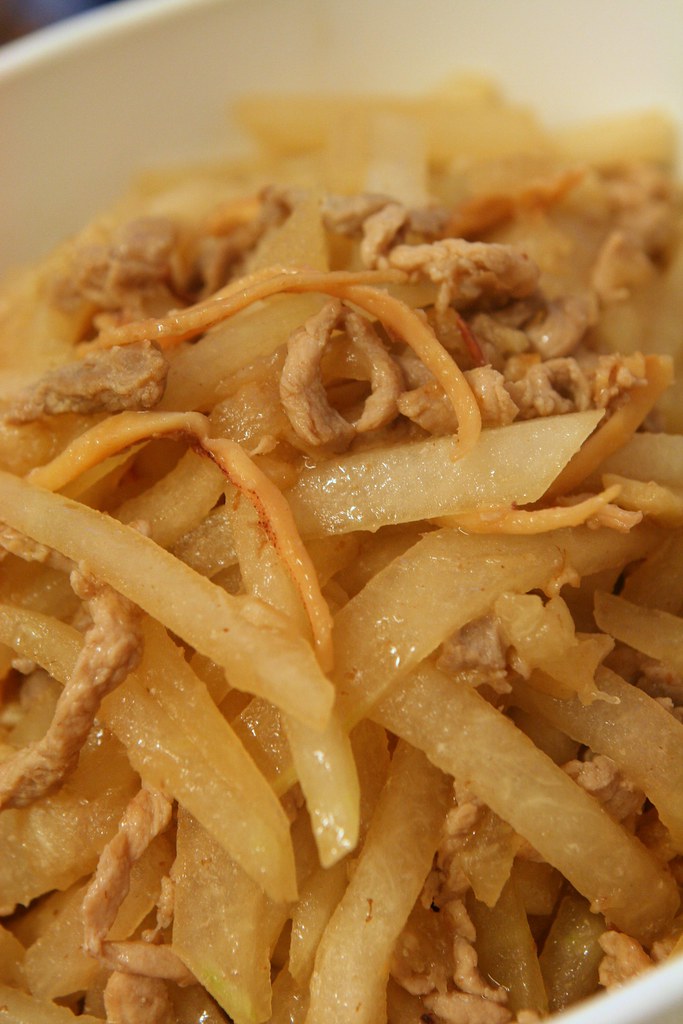
I borrowed this idea from the jicama (yam bean or sengkuang) dish that is usually cooked during festive season with belly pork and thin dried squid strips (Hainanese dish? Not quite sure).  It turned out so well and well received even with Keshia who is a real fusspot where veggies are concerned.  I wasn't very keen to blog this as the picture didn't turn out too well but K and Leanne insisted that I should. 
As you can see the picture is not very attractive as there isn't much color contrast but that is deceiving as far as taste is concerned. The sweetness and the aroma of the winter melon infused with the squid strips is just simply delicious.  

500g winter melon, skinned and cut into strips
1 small dried squid, washed and cut* into very thin strips (can buy it finely cut, in Penang, ie)
100g chicken meat or pork, cut into thin strips
4 cloves garlic, chopped
2 T soy sauce  
1 t corn flour
salt and ground white pepper 

Marinate meat with salt, pepper and corn flour.
Heat 1-2 tablespoons oil in wok, add garlic and fry until fragrant. 
Add meat and dried squid, keep stirring until fragrant and the meat browned. 
Put in winter melon, mix well, add 1/2 cup water and soy sauce, bring to boil and cover. 
Cook for 3 - 5 minutes or until winter melon is cooked through but still with a bit of crunch. Season to taste with salt and pepper.
Dish out and serve hot with rice.

Note: *I find it easier to cut the dried squid before washing and with scissors instead of a knife.
When buying winter melon, better to get one that has thicker skin and thick white powdery surface (which indicate a mature fruit) which is sweeter and more aromatic. 

Monday, June 9, 2008

Chicken Wine Soup

Thought the rainy season had passed but it has been so wet and cold the last two days that it got me thinking of the bottle of rice wine from Terri. What could be better than wong ziu gai (rice wine chicken) at this time? 
During confinement, twice a day I would have the wine soup consisting of only kampong chicken, old ginger (loads of it), sesame oil and wine (not even water to dilute the wine a little).  That worked out to almost 2 bottles of rice wine a day. It is a wonder I didn't turn alcoholic after 5 confinements and how did I manage to stay sober during the 30 days of imprisonment? Or maybe I wasn't after all, happy hour for a whole month! That certainly helped to keep the post-natal depression at bay.
This version is very much toned down. I opted for the Cantonese-style with black fungus and goji but omitted the mushroom as I find it overpowering (I like to taste the wine in my soup). 

1 kampong chicken, cleaned and chopped into pieces
2 thumb size old ginger root, wash off grits and flattened with side of chopper
1/2 cup black fungus, washed and soaked 
2 T goji (wolfberries), washed
3-4 cups rice wine
1 T sesame oil
3-4 cups water

Heat sesame oil in wok, fry ginger until fragrant and add chicken. 
Stir fry chicken pieces until color changed and aromatic, add in black fungus and water. 
Bring to boil, lower heat to simmer for about 15 minutes or until chicken meat is tender. 
Add in the rice wine, bring to boil and lastly, stir in the goji.
Dish out and enjoy with white rice and a simple stir-fried veg.

Note: The water and wine ratio is entirely flexible and so is the soupiness. My family like to drink the soup more than eat the meat and as there are still a few minors around I have to watered down the alcoholic content to a more legally acceptable level :-p. 
I still prefer mine 100% rice wine...