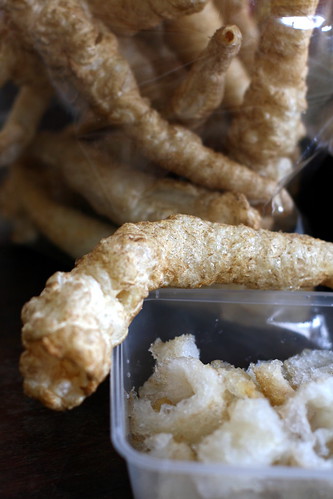
Showing posts with label chinese new year. Show all posts

Monday, February 9, 2009

Arrowroot Chips

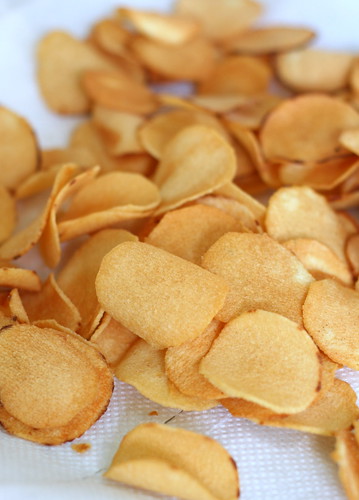
Ben dropped by the house and quickly zoomed in on these. Before he popped them into his mouth I warned him that these might not be what he expect. I knew he had mistaken them for potato chips. These are arrowroot chips. Meant to post this before CNY but forgotten in the midst of all the festive activities, last minute shopping and cooking. 
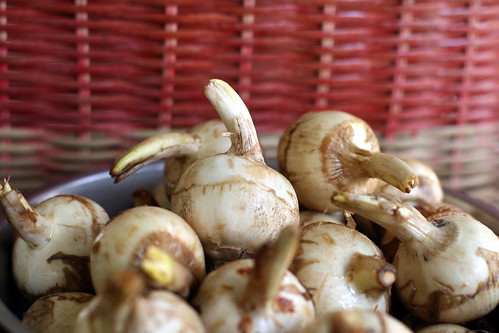
Arrowroots, clad
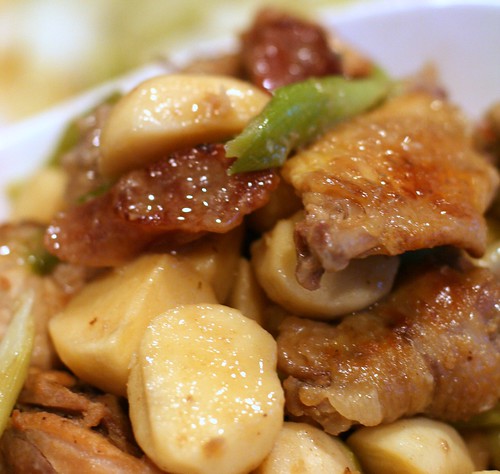
These only come by once a year during CNY. So even when I swear that i won't touch veggies from China, I couldn't resist these. I love them braised with chinese sausage and chicken. The children like them fried as chips (don't think they know what these chips are made of when they pop them into their mouth).
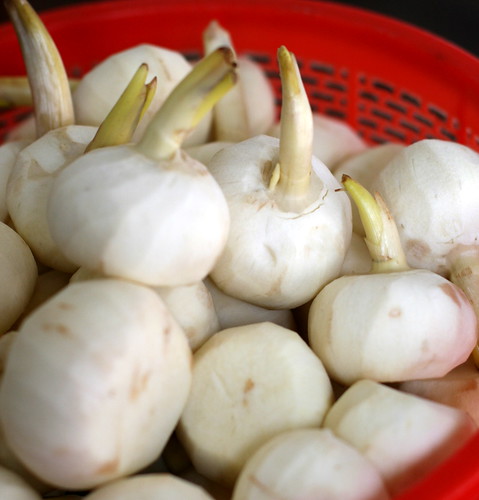
Arrowroots, unclad
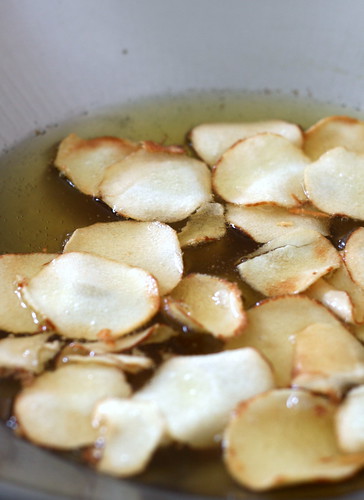
Use a slicer and slice arrowroots directly into hot oil. Rewind---see the previous foto--- have a good reason to leave the tips intact when peeling. I needed something to grab on to when slicing. Do not overcrowd when frying as they will stick together, so just do one arrowroot at one time unless your wok is big and fill with tons of oil. Be ready to lift up the chips fast as they cook and brown very quickly.
 
These were the first few batches and as usual, forgotten that they will continue cooking after lifted from oil. Overly brown and they get too bitter (they are a little bitter to begin with).  If you like, sprinkle on fine salt but sparingly. When cooled, store in airtight container. Make excellent gift for CNY as they resemble gold coins (I know, I know this is a little too late for this CNY but there is always next year, right?). 
I want to wish everyone a very happy and 'full filling' Chap Goh Mei.

Wednesday, January 28, 2009

THE Dinner Of The Year

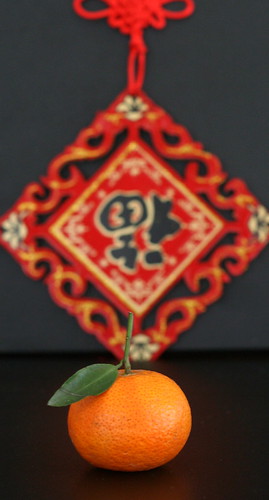
Before we get to the food part, let me wish everyone gong xi fa cai throughout the year of the golden Ox. Why is the Fook character upside down? That is to wish everyone Fook Tau meaning luck, prosperity and everything good arrives.
The Reunion Dinner of the Chinese New Year, we had it at my brother, TM's house. 
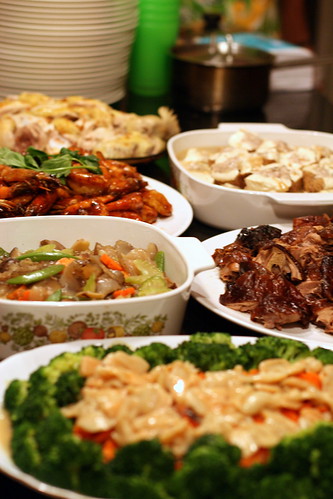
It was a potluck dinner and each was to bring just two dishes...but look what a banquet it turned out to be...

Let's start with the poultry

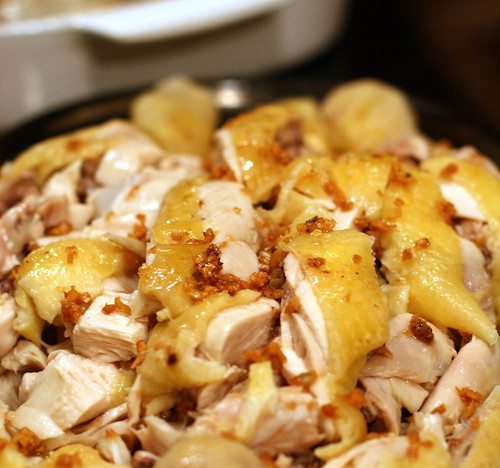
 Bai zhan ji (white cut chicken)
My sis-in-law's signature dish. She had the chicken cooked to perfection. A must-have favorite.

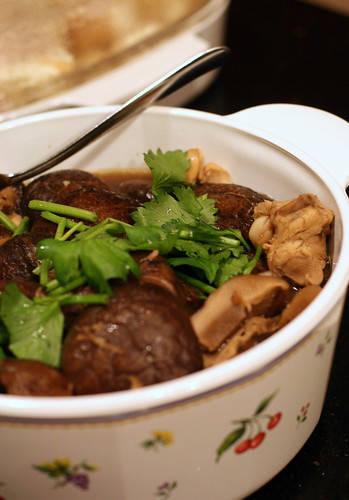
Braised chicken with mushrooms. The succulent mushrooms took center stage here.
 
Roast duck

The seafood
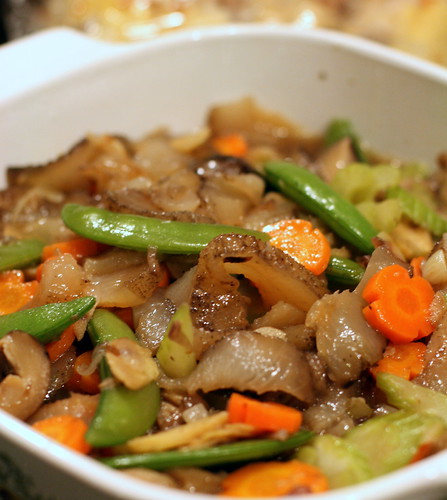
Sea cucumber

Sweet and sour prawns

Deluxe fish cake with crab stick and nori

The porky dishes

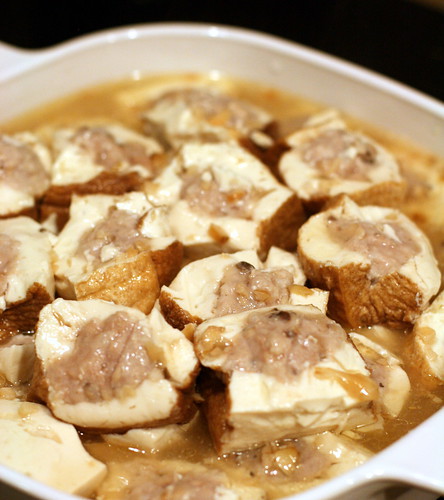
Another must-have Hakka fare, yong tofu

A cold dish of pork trotters and jelly fish pickles

The Vegetables

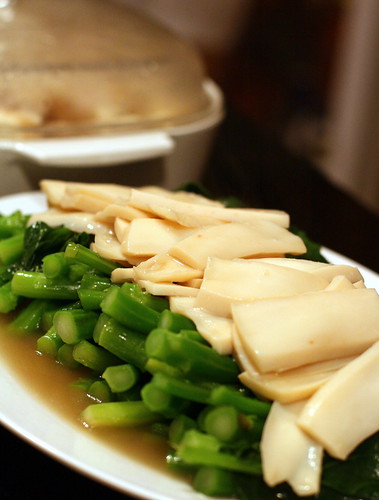
Baby kailan 

Broccoli and carrots

All these for fifteen of us... one new year's resolution made less than a month ago thrown out of the window :p.
Once again, have a happy, healthy, harmonious and prosperous year of the Ox.

Thursday, January 22, 2009

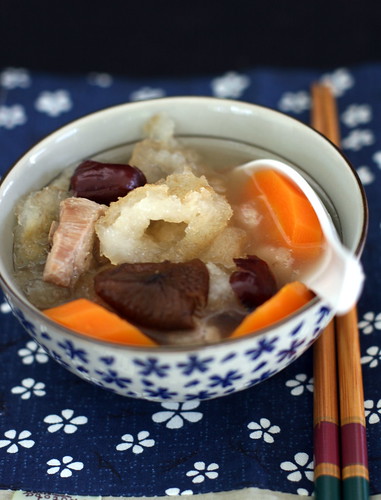
Fish Maw Soup


When we were growing up, only during CNY festive season (or on wedding dinners) that this dish was served. So whenever the aroma of this fishy delicacy is detected, it triggers my brain cells to kicked into an overdrive of celebration gear. As I wasn't quite in a festive mood even a week before the CNY, I felt I had to self induce some. So I cooked the fish miaw soup and that did the trick because that same day I began to bring out the CNY deco for the house :-D.
 
Fish maw is the gas bladder of a fish that helps it to change depth without swimming.
I have always bought them ready to cook. Usually they come in the dried form and you would have to deep fry them first before they can be added to a dish.
This batch of fish maw we bought this year was from Hong Kong and was processed a little differently. They were not deep fried in oil but deep fried in a wok of tiny rock salt pebbles, I was told.
I prefer this method becouse I have always had doubts about the freshness of the deep frying oil used commercially. Also, when the maws are deep fried in oil they have to be consumed within a short time or the oil would turn rancid and rendered the maw inedible.

Two fish maws when soaked yield about 2 cups.

All you need for the soup are:
1 kampong chicken, cut into small pieces
2 carrots, peeled and sliced or diced
10 red dates, washed and stoned (flatten them with the side of a chopper and the stones can be easily remove)
some dried mushrooms, soaked until soft
a bowl of soaked fish maw
2-3 L water
salt and pepper 

~Bring water to boil.
~Add the chicken and when the water begins to boil again, lower heat and simmer for 1/2 hour.
~Add carrots, dates and mushroom and simmer for another 1/2 hour.
~Add fish maw, bring to boil and let it cook for about 3 - 5 minutes.
~Season to taste.
~Serve hot.

Beside making soup, fish maw can be cooked stuffed with minced meat like yong tau foo or braised with chicken and mushroom, all delicious.

Wednesday, February 20, 2008

Braised Chicken With Arrowroots

One of my many favorite cny dishes. This is one dish that doesn't need much seasoning or extras to make it good.
Very simple but delicious, with each ingredient complimenting one another to make this dish special, especially as arrowroots are usually found only during the cny season in this part of the world.
I would make this dish as soon as I could find the arrowroots in the market, buy enough and then ration to last until chap goh mei.

Braised Chicken With Arrowroots
1 chicken or 4 thighs, cut into small pieces
500g arrowroots, peeled and half or quartered

2 Chinese sausage, cut into pieces
3 - 4 leek, rinsed off grits and cut into same size as sausage

3-4 cloves garlic, peeled and coarsely chopped

~Season chicken pieces with some light soy sauce.

~Add 2 tablespoon of cornflour and mix well.

~Heat 3-4 tablespoon oil in the wok and brown chicken pieces. Drain.

~Leave about a tbsp of oil in the wok, add the sausage and garlic and fry till fragrant.

~Put the arrowroots and browned chicken in and add about a cup or two (depends on how much gravy you like) of stock or water.

~Bring to boil and lower heat to simmer.

~Simmer for 30 minutes or until chicken and arrowroots are soft.

~Add the leek and cook for 2 -3 minutes.

~Add salt or soy sauce to taste.

~Dish out and serve hot with steaming white rice.

These are the last of the veggie and will have to wait another year for the next dish/date with these tubers!

Leaving for Macau, Hong Kong and Shenzhen later today for a few days of eating and shopping binge. Hopefully be back with many good chows!!

Happy Chap Goh Mei to all ! (which is tomorrow and we'll be in HK :D)

Jo

Monday, February 18, 2008

Fa Cai Fried Rice

I love fried rice, to cook and to eat. Especially at this time when the fridge is packed with so many ingredients to choose from.
This dish was made in between the busy mahjong sessions. Quick and easy but extremely delicious. This is truly a feast in a dish packed with all the festive's essence.
More liau than rice :P


As the exact amount of ingredients in this dish isn't crucial, I do not specify the amount so you are free to experiment - add or omit, entirely up to you.
These are the many goodies I found in my fridge...


Fa Cai Fried Rice
~overnight cooked rice, loosened
~fresh prawns, peeled and diced
~chinese sausage, thinly sliced
~carrots, peeled and diced
~pumpkin, peeled and diced
~dried prawns, soaked and chopped
~leek, sliced
~fresh mushroom (shitake, button or enoki), cleaned and sliced
~yam, peeled, diced and deep fried (I used the 'khew nyuk' leftover yam)
~celery, diced
~red pepper, de-seed and diced
~eggs
~garlic, chopped
~big onions, peeled and diced
~oyster sauce
~light soy sauce
~sesame oil
~oil
~salt and pepper

Heat oil in a hot wok.
Add the chinese sausage, onion and dried prawns then garlic and fry till fragrant.
Add pumpkin, yam, carrots and cook for 2-3 minutes until veggies soften.
Add fresh prawns and leek.
Push these to one side of wok (take out if wok too small), add another 1-2 tablespoons oil and add eggs.
Keep stirring to break up the eggs, add rice and put in the rest of the fried stuffs.
All these are done over very high heat so constant stirring and tossing is essential to avoid burning.
Add the soy sauce, oyster sauce, salt and pepper to taste.
Lastly add the red pepper and celery to give an extra crunch and sweetness to this special fried rice.
Dish out and sprinkle some chopped spring onion to garnish.

Jo

Saturday, February 16, 2008

Cheats Vegan

First day of Chinese new year for many (especially the Chinese Buddhists) is a time for vegetarian dishes (zhai cai 齋菜). That makes sense after the sumptuous reunion feast the night before. We also do vegetarian but not strictly, tend to cheat here and there.
This so-called vegetarian dish 'loh han cai' (羅漢齋) is a must on our first day. A myriad of ingredients combined to create a distinct dish fit for the king!
Every household has its own version of this classic dish and most of the time it is not vegetarian because big chunks of siew yuk or some form of meat are added.
Dried mushrooms, ginkgo nuts, dried oysters (non-vegetarian but with great sound 'hau si' means 'auspicious things or events'), sweet bean curd sheets, lily buds, carrot, black fungus, mung bean vermicelli (tang hoon), red dates, Chinese cabbage, fatt choi (black moss), etc.
All these ingredients soaked, drained and saute individually with oyster sauce and then stewed together in a chicken stock broth seasoned with oyster sauce (some add nam yee, red fermented bean curd) over low heat until all the flavors come together in a most delicious yummy mash!

And K made a cashew nuts salad which is also not entirely vegetarian as chicken strips are used but still light and easy on the palate and stomach. Very refreshing.

K's braised shiitake mushrooms. 100% vegan!

Jo

Thursday, February 14, 2008

Salmon Yee Sang 鱼生 (raw fish salad)

I think I better get this posted before the chap goh mei (15th day of the lunar new year when the new year celebration officially ends) so that you can also 'lou sang' without having to dig too deeply into your pocket!

Yee sang is a must-have CNY dish for us not only because it is sooo auspicious but it also tastes sooo good. The word yee (fish) means abundance and surplus. Sang means raw or lively. So yee sang literally means “raw fish” and symbolizes abundance, prosperity and vitality. What more can you ask for?

This recipe was adapted from Amy Beh's vegetarian dish featured in the Star newspaper many years ago. Since then, we have been doing it every year and it is a big hit with the whole family.
It requires a little more preparation but it is really well worth the effort.
No coloring, no preservatives, no msg and it is super delicious.

Traditionally, this was eaten on the seventh day of new year when the fishermen in Guangzhou celebrate their new year but nowadays, it is served all through the new year season.

Salmon Yee Sang
~2 cups white radish, shredded and soaked in cold water
~2 cups carrot, shredded and soaked in cold water
~1 cup green mango, shredded
~50g spring onions, shredded and soaked in cold water
~1 red chili, shredded
~2 cups pickled papaya, shredded
~6 pickled leeks, shredded
~2 cups pomelo wedges, peeled and separate the sacs
~4 kaffir lime leaves, finely shredded
~20g young ginger, finely shredded
~1 pair yao char kwai, sliced thinly and deep-fried until crispy (I substituted
this with homemade deep fried crackers made of flour, nam yee, sesame seed, salt and water)
~1 cup sweet potato, finely shredded and deep fried
~1 cup yam (taro), finely shredded and deep fried (not in the original recipe but I added this cos I love yam and it has an auspicious sound 'wu tao' means 'good beginnings' )
~2 tablespoons toasted sesame seeds
~3 tablespoons roasted peanuts, pounded coarsely
~200g chilled sashimi-grade salmon, thinly sliced
~1/2 lime

Sauce
~100g plum sauce (original recipe - 300g)
~1 tbsp apricot jam
~3 tbsp lime juice
~1 tbsp honey (original recipe - 3T which I found too sweet)
~1 tbsp sesame paste
~1 tsp sesame oil
~1/2 tsp salt or to taste
~1/2 tsp Chinese five spice powder, put into a red packet

Combine the sauce ingredients in a small saucepan. Bring to a low simmering boil. Leave aside to cool completely before use.

Drain the shredded carrot, radish and spring onion well. Arrange the shredded ingredients attractively on a big, round serving platter. We used a huge 50 cm serving glass plate for the 14 of us!
Squeeze half a lime over the fish slices and arrange them on top of the shredded ingredients.

To serve, pour the sauce over the yee sang and sprinkle with the five-spice powder, the sesame seeds and roasted peanuts.

This is the fun part when we toss the salad together with chopsticks, wishing everyone good fortune, good health and greater success and lift everything higher and higher.
Jo

Monday, February 11, 2008

Khew Yuk (pork with yam)

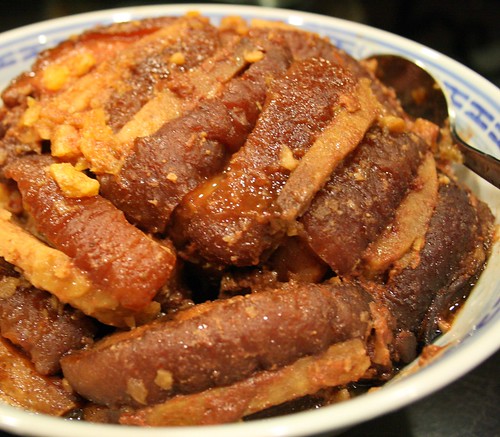
My first culinary inspiration must have come from my parents because I can still recall my father preparing the famous traditional Hakka dish called 'khew yuk' - a dish which combines pork belly slices with yam (taro).
This dish has a long and tedious process of preparation so it is only worthwhile to do a big batch at one go and share among family and friends.
That's one reason why he only made it during festive seasons.
I have watched him prepare this dish many times before but have never had the inclination to do it myself until last year...
But my dad didn't leave behind any recipes, he just went with his grey cells and taste buds, so I was at a loss as to how go about preparing this dish without him to consult.
Asked a few friends until I hit the jackpot... Mrs. Loh, a fantastic cook for traditional Hakka dishes and a good friend.
The kind soul that she is, came to the house and guided me through the whole process step by step.
Her version is very similar to my Dad's (almost identical except for the candied mandarin orange).
She came over and we did 10 bowls for this cny!
And with her consent I share with you this fantastic recipe:

Hakka's Khew yuk
Makes about 8 big chinese soup bowls

6 kg pork belly (cut into 3 long chunks, go with the grain)
4 kg yam
Oil for deep-frying
300g garlic, chopped
50g shallots, chopped

500 gm nam yee (red fermented bean curd) - get the one packed in this small brown jug

100 gm chit pian (candied mandarin orange), minced
1 - 1 1/2 tablespoon five-spice powder

1-2 star anise, optional
1/2 cup brandy or 'mei kuei lu' (chinese rose wine)*

300g crushed rock sugar, dissolved in 1L hot water

light soy sauce

dark soy sauce


To prepare the yam:
1) Peel and cut into 4 cm x 6 cm and 1 cm thick slices.
2) Rub the pieces lightly with light soy sauce.
3) Deep fry in hot oil until golden brown. Drain and keep aside.

To prepare the pork:
1) Blanch pork in boiling water for about 5 minutes and drain.
2) Cut each piece lengthwise about 6 cm wide.
3) Rub light and dark soy sauce all over the pork.
4) Deep fry in hot oil until skin turns brown and crispy. Drain.
5) Soak the fried pork in water until the skin soften.
6) Cut into 1 cm thickness.
7) Marinate pork pieces with a tablespoon of num yee, 4-5 tablespoons minced garlic, 1 tablespoon shallots, 1/2 T 5-spice powder and 2 T chopped chit pian.
8) Save about 3-4 T each of garlic and chit pian for the final assembly of the dish (to sprinkle on the bottom of each bowl before assembling the meat and yam).

Sauce: (the most crucial stage - either make or break the dish)
1) Heat 5 T oil and fry the remaining garlic and shallots until fragrant and light golden in color.
2) Add nam yee, constantly stirring, smashing it up until it turns fragrant and the oil rises.
3) Add in the rock sugar water, chit pian, the rest of 5-spice powder and soy sauce.
Now taste - it should taste a tad more salty, sweet and intense than the final result you want because the steaming will dilute the sauce a little.
Bring to boil. Let it cool.
Add the brandy.

To assemble:
Ready 8 bowls.

~Sprinkle about 1/2 teaspoon of garlic and a pinch of minced chit pian at the bottom of each bowl.
~Spoon a tablespoon of the sauce into each bowl.
~Dip a piece of pork and yam into the sauce and place them in a bowl side by side with the pork skin facing downwards.
~Repeat until each bowl is filled.
~Place the leftover-odd sizes pork and yam on top of the assembled bowls to form a dome shape.
~Spoon the remaining sauce equally onto each bowl.
~Steam for 2-3 hours (depending on the age of the piggy used :p).

This dish can be made 2 to 3 weeks in advance. When cooled, wrap tightly in foil and plastic, and store in the freezer.

To serve, re-steam for 30 minutes or more. Take an empty same-size or larger bowl, place mouth-to-mouth on top of the bowl of khew yuk, hold the two bowls firmly with both hands and turn over quickly so that the khew yuk now sits in the empty bowl with the pork skin-side up.

Wanted to post this before the lunar year but just didn't manage to get the lengthy instructions done in time. I hope this post is not too late for you to try out the recipe before chap goh meh (15th day of the lunar year).
Good night.

Jo
Edit: *My brother called and corrected me that our dad used the chinese cooking wine called 'mei kuei lu' (rose wine) and not brandy.
I wasn't sure which one is a genuine good quality brand (so many imitation these days) so brandy was a safer option. Do use the rose wine if you can be sure of its quality, more authentic :D

Wednesday, February 6, 2008

CNY @ Square Table

We will be taking leave from blogging for the cny period. Won't have much time to cook or to post.
The reason being, we will be very busy with our yearly ritual, that is round-the-clock construction of the Great wall of China on the square table :p
Mahjong plays a very big role on this auspicious holiday in this family because this is the only time in the year that we find ourselves together with free time to play this game. In a way, this actually makes the game so much more appealing and eagerly awaited.
Our stake is so meager that it is embarrassing to play with anyone other than the family (can be winning the whole day and still can't earn enough to cover the cost of a decent meal!). Definitely no inflation here. I don't think it is going to be any different this year. It is more a game for the family to gather around to catch up with one another and share the past year's happenings as we don't get to see each other that often during the year.
We always start on new year's eve immediately after the reunion dinner to get re-acquainted as we tend to forget the game after not playing for a year.

So here I am, taking the bricks out to dust and clean, preparing for the opening act.

Hello, familiar faces. Good to see you and so glad to be together again.


With these, let us wish you and your family loads of good health, wealth and harmony
plus all of these...

恭喜發財

Gong Xi Fa Cai (Congratulations and be prosperous )

歲歲平安

Sui Sui Ping An (Peace year after year)

年年有餘

Nian Nian You Yee (surpluses and bountiful harvests yearly)